

Jade Gas Holdings (ASX: JGH) — Mongolia's First Commercial Gas Operation Advances Toward Production Licence

Written by Christopher Hall, AdvDipFP | Authorised Representative, AFSL 526688 | May 2026
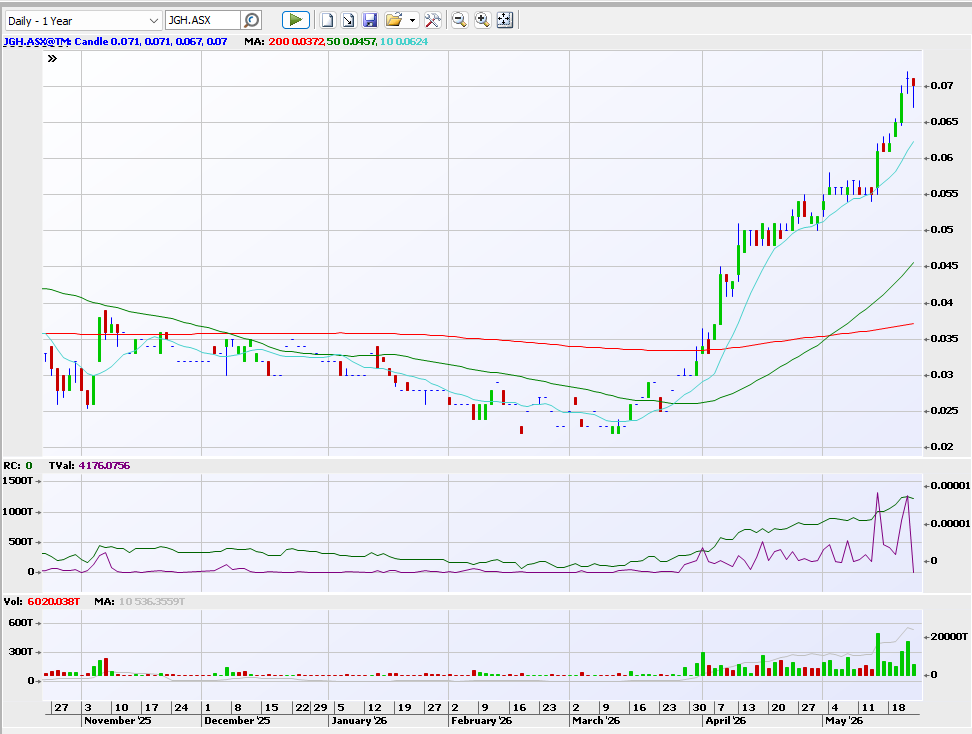
Jade Gas Holdings Limited (ASX: JGH) is a coal bed methane (CBM) gas developer focused on the South Gobi region of Mongolia. The company ranked second in the FMP Top 10 Momentum List with a +176% quarterly gain and a +155.56% return since Launch Pad entry — the result of three sequential regulatory milestones delivered between March and April 2026, culminating in formal approval from Mongolia's Mineral Resources and Petroleum Authority (MRPAM) on 28 April 2026. That approval arrived at the same moment the global LNG supply chain was under acute pressure from the Iran War and the effective closure of the Strait of Hormuz — a geopolitical development JGH could not have forecast, but whose timing proved decisive for the company's momentum trajectory.
Why Did Jade Gas Holdings Appear in the FMP Top 10?
JGH entered the FMP Top 30 momentum universe approximately 38 days before this article was published and entered the Launch Pad 45 days ago. The quarterly gain of +176% ranked third among all Top 10 companies by quarterly performance at the time of the data snapshot.
Three ASX announcements between 2 March and 28 April 2026 form the catalyst sequence:
2 March 2026 — Appraisal program concluded. Jade Gas completed its appraisal program for the TTCBM Project at the Red Lake gas field, submitting its formal appraisal report to Mongolian regulatory authorities. This marked the end of the exploration and appraisal phase and the beginning of the formal development pathway. (Jade Gas Holdings, ASX: JGH, 2 March 2026)
31 March 2026 — A$1.8 million placement completed. The company secured A$1.8 million from existing sophisticated investors at A$0.03 per share — a 10.5% premium to the 15-day volume-weighted average price. Applications were scaled back to meet the agreed total, reflecting strong investor demand at that price point. (Jade Gas Holdings, ASX: JGH, 31 March 2026)
28 April 2026 — MRPAM approves the Appraisal Report. Mongolia's Mineral Resources and Petroleum Authority formally approved Jade's Appraisal Report for the TTCBM Project. This confirms completion of the appraisal phase, establishes the commerciality of the discovery, and opens the formal pathway to reserve booking, Plan for Development of Operations submission, and ultimately a gas production licence. (Jade Gas Holdings, ASX: JGH, 28 April 2026)
Each announcement arrived during a period of significant geopolitical change in global energy markets — a confluence that amplified the price response to each milestone.
What Pattern Did JGH Show?
JGH's chart behaviour through this period is consistent with what momentum researchers describe as an episodic pivot — a sharp, catalyst-driven price move that resets a stock's trajectory and attracts a new, broader investor base.
Pradeep Bonde, founder of Stockbee and pioneer of Episodic Pivot methodology, identifies the structure that produces the most powerful moves:
"You have to understand what kind of stories are working in the market currently. Anything related to AI is a story which works very well. SMCI had both components — it had a real catalyst plus it had AI which is a story kind of a thing, and as a result of this the stock made such a phenomenal move."
JGH carries both components Bonde describes. The real catalyst is specific and dateable: MRPAM regulatory approval on 28 April 2026, clearing the formal path toward Mongolia's first gas production licence. The thematic narrative is the Iran War and the Asian LNG supply disruption — a macro shift that made Mongolia's CBM gas development immediately more strategically relevant to the region. The combination of a verifiable regulatory milestone arriving inside a live energy security crisis is consistent with the structure Bonde describes as producing episodic moves.
For a full explanation of how episodic pivots are identified and traded, see What is Episodic Pivot Trading? The Complete Guide to Catalyst-Based Momentum Trading.
How Did the Global LNG Supply Shock Create a Tailwind for JGH?
To understand why JGH's regulatory progress translated into the momentum it did, the macro environment immediately surrounding it matters.
In the fourth quarter of 2025, Australian LNG export values were declining — falling from A$65 billion in 2024–25 toward A$53 billion in 2025–26 and projected lower again to A$47 billion in 2026–27, according to the Australian Government's Resources and Energy Quarterly (December 2025, Department of Industry, Science and Resources). Higher US LNG supply had pushed Asian spot prices from approximately US$15 per MMBtu in early 2025 to US$11 per MMBtu by late 2025. Falling commodity prices in any sector produce a predictable response: projects are deferred, drilling programs are slowed, and capital deployment into new supply is reduced.
JGH was advancing through this environment regardless — completing drilling, finalising its appraisal program, and progressing its regulatory submissions during the same period that broader sector activity was moderating.
On 28 February 2026, the United States and Israel commenced military strikes against Iran. The consequences for global energy markets were immediate. Iran's effective blockade of the Strait of Hormuz — a critical transit route for Qatari LNG exports into Asian markets — created an acute supply shortage across the region that has since driven price responses from New Zealand to Australia.
In New Zealand, gas reserves had already fallen 23% year-on-year to 731 petajoules, according to data from the Ministry of Business, Innovation and Employment cited by New Zealand Energy Minister Simeon Brown. The Frankley Road Natural Gas Monthly Index — the benchmark wholesale gas price on Transpower's emsTradepoint platform — rose from NZ$7.30 per gigajoule on 4 February 2026 to a peak of NZ$16.36 per gigajoule on 4 May 2026, a +124% increase in three months. New Zealand's government has now advanced plans for a NZ$1 billion LNG import terminal in Taranaki, targeting operational capacity as early as 2027. (Lujia Wang, Oil Price Information Service / Dow Jones & Co., 22 May 2026)
In Australia, Energy Minister Chris Bowen announced a domestic gas reservation policy requiring producers to set aside the equivalent of 20% of exports for domestic use from mid-2027 — making Australia the first gas-exporting country to implement any form of reservation requirement. (James Glynn, The Wall Street Journal, 2026)
The broader energy security dynamic at work in this rotation was examined in the FMP article on Yancoal (ASX: YAL): Iran War Coal Price Momentum, which explains how LNG supply disruptions through the Strait of Hormuz rotate Asian energy demand toward available alternatives — and how companies positioned to supply those markets attract disproportionate investor attention during supply shocks.
JGH's A$1.8 million placement at a 10.5% premium in late March 2026 — well-supported with applications scaled back — was received by sophisticated investors in precisely this shifting context. The MRPAM approval that followed four weeks later landed in a market that was already reassessing the value of projects advancing toward new gas supply.
The result was that JGH entered the Iran War period already further advanced along its regulatory pathway — a position its own ASX announcement sequence confirms.
Remember that past performance is no guarantee of future results, and all trading involves risk.
What Is Jade Gas Holdings and What Is the TTCBM Project?
Jade Gas Holdings Limited (ASX: JGH) is a gas exploration company focused on the coal bed methane potential of Mongolia. Coal bed methane is natural gas — primarily methane — extracted from coal seams rather than conventional reservoirs. The company's flagship asset is the TTCBM Project, a CBM development covering the Production Sharing Agreement area of the Tavantolgoi XXXIII unconventional oil basin in the South Gobi region of Mongolia.
The project is operated through Jade's subsidiary Methane Gas Resource LLC (MGR), a joint venture partnering with Erdenes Methane LLC — the Mongolian Government's representative in the venture. The TTCBM Project holds a 2C Gross Unrisked Contingent Resource of 246 billion cubic feet, as reported by Jade Gas Holdings in an ASX release dated 23 August 2022. The company has confirmed it is not aware of any new information that materially affects this estimate.
Jade also holds the BNG Project — a second CBM joint venture with Hong Kong-listed Mongolia Mining Corporation Limited (MMC) covering CBM rights over MMC's Baruun Naran coal mine, immediately adjacent to the TTCBM Project.
The Red Lake Development Area covers 60 square kilometres and encompasses 165 core holes, 28 of which have gas content measurements. Average thickness of total coal is 100 metres; average thickness of gas-bearing coal is 37 metres.
Management has outlined Phase 1 of the development as a modular campaign of up to 175 wells targeting LNG supply for Mongolia's local transport network and mining and industrial power users. Management has further indicated the broader field development contemplates approximately 800 wells and a project life exceeding 30 years. Neither the Plan for Development of Operations nor the exploitation licence has yet been submitted or approved. (Jade Gas Holdings, ASX: JGH, 28 April 2026)
Jade's stated strategy is to displace Mongolia's dependence on imported fuels — including diesel and coal-fired power — by developing domestically produced natural gas as a cleaner, locally sourced alternative.
What Are JGH's Key Momentum Metrics?
Metric | Value |
Date entered FMP Top 30 | Approximately 14 April 2026 |
Quarterly gain at coverage | +176% |
Days on Top 30 at publication | 38 |
Launch Pad entry | Approximately 7 April 2026 |
Return since Launch Pad entry | +155.56% |
Thematic category | Natural Gas / CBM / Mongolia Energy |
Data source | FMP Momentum Research, 20 May 2026 |
What Is Mongolia's Regulatory Pathway to a Gas Production Licence?
Following MRPAM's approval of the Appraisal Report on 28 April 2026, the formal regulatory sequence for the TTCBM Project proceeds through three remaining steps:
Reserve booking — in progress. Jade has submitted its maiden gas reserve booking to the Mongolian Minerals Reserve Council (MRC) for validation and registration under Mongolia's mineral and petroleum reporting standards. The proposed reserve booking covers a minimum economic project analysis of 4.2 square kilometres evaluating one coal seam — a procedural step within the Mongolian development pathway. MRC acknowledgment will formally register the TTCBM Project's reserves.
Plan for Development of Operations — pending MRC acknowledgment. Upon MRC acknowledgment of the reserve booking, Jade will submit its PDO — the formal development blueprint defining technical scope, infrastructure design, production forecasts, and environmental management commitments.
Exploitation licence — pending PDO approval. Following PDO approval, Jade will lodge an exploitation licence application, enabling the transition from appraisal to commercial field development and gas production at scale.
The MRPAM approval received on 28 April 2026 confirms the commerciality of the discovery. It does not guarantee subsequent regulatory approvals — each step requires separate determination by the relevant Mongolian authority.
Why Is Natural Gas and Asian Energy Security a Leading ASX Thematic in 2026?
JGH sits within the natural gas and energy security thematics that have become increasingly prominent across Asian equity markets as the Iran War has reshaped regional supply assumptions.
Mongolia's CBM development is directly relevant to a region where three dynamics are converging: domestic gas reserves are declining in established markets such as New Zealand, new reservation policies are constraining available export supply in Australia, and the Strait of Hormuz disruption has removed a critical LNG transit route from the supply equation.
No FMP Tier 2 thematic hub page for the natural gas thematic currently exists. When the natural gas hub page is published at /momentum-stocks/natural-gas, JGH's company hub will be linked from that page as a primary case study in Mongolia CBM development.
For the current list of leading ASX momentum stocks across all active thematics, see the FMP Momentum Leaders page.
Frequently Asked Questions
What is Jade Gas Holdings and what does the company do?
Jade Gas Holdings Limited (ASX: JGH) is an ASX-listed gas exploration company focused on the coal bed methane potential of Mongolia. CBM is natural gas — primarily methane — extracted from coal seams rather than conventional reservoirs. Jade's flagship asset is the TTCBM Project at the Red Lake gas field in Mongolia's South Gobi region, operated through a joint venture with Erdenes Methane LLC, the Mongolian Government's representative in the venture. The company's objective is to deliver what it describes as Mongolia's first significant commercial gas operation, supplying the local transport, mining, and power sectors.
Why did JGH appear in the FMP Top 10 Momentum List?
JGH ranked second in the FMP Top 10 with a quarterly gain of +176% and a +155.56% return since Launch Pad entry. The primary catalyst was formal approval of Jade's Appraisal Report by Mongolia's MRPAM on 28 April 2026 — clearing the pathway to reserve booking, PDO submission, and a gas production licence. This arrived during the Iran War and the disruption to Strait of Hormuz LNG shipping, which created acute gas supply pressure across Asian markets and elevated investor focus toward companies advancing new gas supply projects.
What is an episodic pivot and does JGH show one?
An episodic pivot is a sharp, catalyst-driven price move that resets a stock's momentum trajectory and draws a broader investor base into the name. The concept was formalised by Pradeep Bonde at Stockbee and has been widely adopted by systematic momentum traders. The strongest episodic pivots combine a verifiable real catalyst — such as a regulatory approval — with a hot thematic narrative that gives investors a structural reason to hold beyond the initial reaction. JGH's MRPAM approval arriving inside the Iran War LNG disruption narrative is consistent with this dual-component structure. For a full explanation, see What is Episodic Pivot Trading?
What is the TTCBM Project and how advanced is it toward gas production?
The TTCBM Project is Jade's flagship CBM development in Mongolia's South Gobi region. It holds a 2C Gross Unrisked Contingent Resource of 246 billion cubic feet (August 2022). As at April 2026, Jade has completed its appraisal program, received MRPAM approval for the Appraisal Report, and submitted its maiden gas reserve booking to the Mongolian Minerals Reserve Council. The next steps are MRC acknowledgment of the reserve booking, submission and approval of the Plan for Development of Operations, and lodgement of the exploitation licence application. Management has outlined Phase 1 as a modular development of up to 175 wells supplying LNG to Mongolia's local transport and power sectors.
How does the Iran War and the Strait of Hormuz closure affect JGH?
Iran's effective blockade of the Strait of Hormuz following US-Israel strikes on 28 February 2026 disrupted Qatari LNG exports — a critical supply route into Asian gas markets. The result has been sharp rises in regional wholesale gas prices: New Zealand's benchmark gas index rose +124% in three months to NZ$16.36/GJ, and Australia has implemented a domestic gas reservation policy requiring 20% of LNG exports to be set aside for domestic use. This supply pressure environment has increased the strategic relevance of projects advancing toward new gas production in the Asia-Pacific region. The mechanism by which LNG disruptions rotate Asian energy demand was explored in the FMP article Yancoal (ASX: YAL): Iran War Coal Price Momentum.
What is the regulatory pathway to a gas production licence in Mongolia?
Mongolia's gas development pathway is administered by the Mineral Resources and Petroleum Authority (MRPAM) and the Mongolian Minerals Reserve Council (MRC). The sequence is: appraisal program completion → MRPAM approval of the Appraisal Report (received 28 April 2026) → reserve booking registration with the MRC → Plan for Development of Operations submission and approval → exploitation licence application, enabling commercial field development. Each step requires separate regulatory determination. MRPAM approval does not guarantee subsequent approvals, and regulatory timeline risk remains a material consideration for any assessment of JGH's development schedule.
Track the ASX Momentum Leaders
The FMP Top 10 Momentum List tracks the ASX's strongest-moving stocks daily, assessed by price action, volume, and relative strength. JGH ranked second with a +176% quarterly gain and a +155.56% return since Launch Pad entry.
To follow the companies currently leading the ASX momentum universe, visit the FMP Momentum Leaders page.
Educational Disclaimer: This content is for educational purposes only and does not constitute financial advice. Past performance is no guarantee of future results. Consider your financial situation and seek professional advice before making investment decisions.
Finer Market Points Pty Ltd, CAR 1304002, AFSL 526688, ABN 87 645 284 680. This general information is educational only and not financial advice, recommendation, forecast or solicitation. Consider your objectives, financial situation and needs before acting. Seek appropriate professional advice. We accept no liability for any loss or damages arising from use. Authors and presenters may hold positions in discussed companies and investment products.
Sources
# | Source | Type | Date |
1 | Jade Gas Holdings (ASX: JGH) — "Jade Completes First Step Toward Gas Production Licence" | Primary — ASX announcement | 28 April 2026 |
2 | Jade Gas Holdings (ASX: JGH) — "Jade Raises A$1.8m to Deliver Mongolia's First Gas Operation" | Primary — ASX announcement | 31 March 2026 |
3 | Jade Gas Holdings (ASX: JGH) — "Major Project Milestone Achieved with Conclusion of Appraisal Program" | Primary — ASX announcement | 2 March 2026 |
4 | Lujia Wang, Oil Price Information Service (OPIS / Dow Jones & Co.) — "New Zealand LNG Import Terminal Plans" | Tier 2 — news article | 22 May 2026 |
5 | James Glynn, The Wall Street Journal — "Australian Government Announces Domestic Gas Reserve From Mid-2027" | Tier 2 — news article | 2026 |
6 | Australian Government, Dept of Industry, Science and Resources — Resources and Energy Quarterly December 2025 | Tier 1 institutional | December 2025 |
7 | Pradeep Bonde — Stockbee, Episodic Pivot methodology | Tier 1 practitioner | Referenced via FMP knowledge base |
8 | Christopher Hall, Finer Market Points — "Yancoal (ASX: YAL): Iran War Coal Price Momentum" | Internal FMP article | March 2026 |
Comments